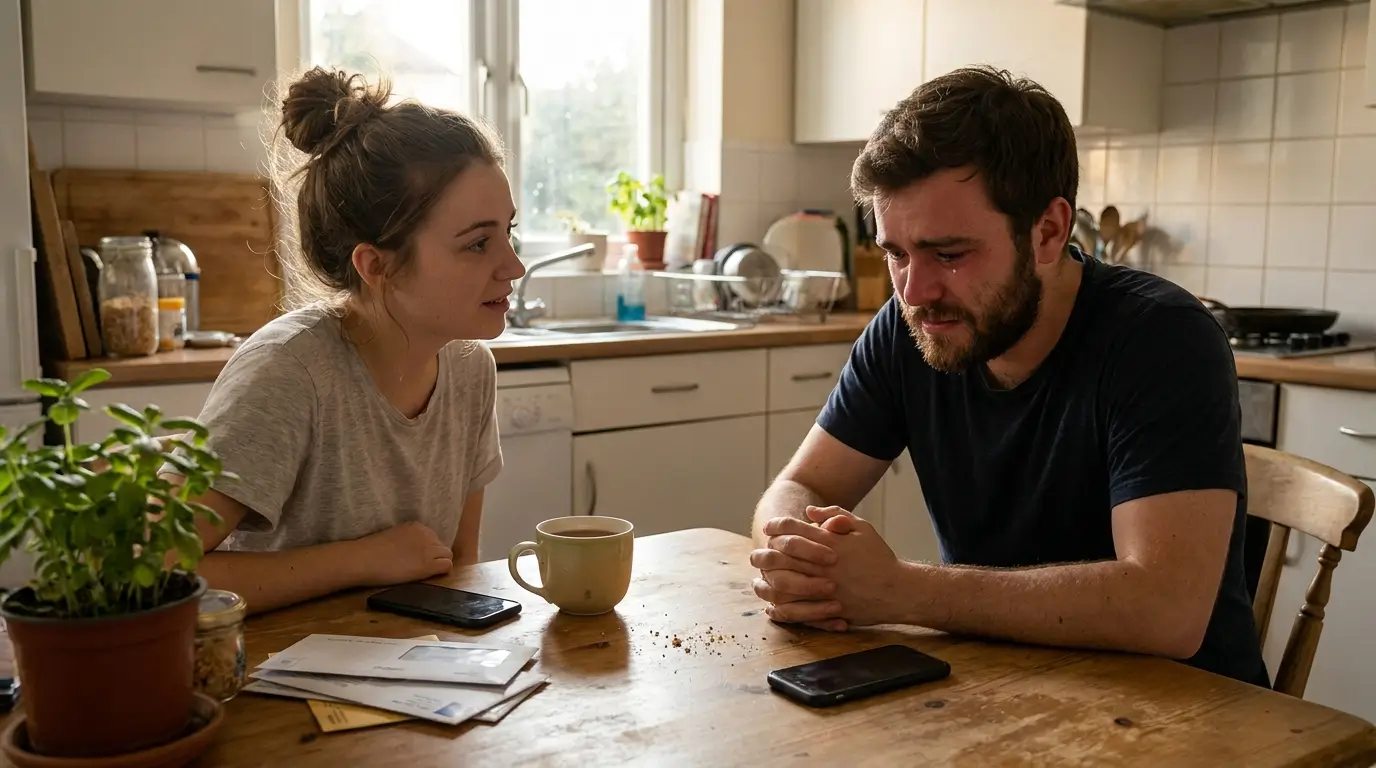
You can love your brother or sister and still not want to spend every weekend with them. Sounds harsh written down, especially if you grew up in a family where siblings were supposed to stay close no matter what happened between you.
But adult sibling relationships are almost never as simple as childhood memories make them look. Years of comparison, old fights, a parent who clearly favoured one of you, different life choices, hurt that never actually got addressed — all of it adds up into a distance that can feel impossible to cross by the time you're both adults with your own families.
Sometimes the goal really is getting close again. Sometimes it's just peace. Those are not the same thing, and mixing them up is where a lot of people get stuck. A healthy sibling relationship doesn't have to mean best friends again. It might just mean sitting at the same family dinner without sarcasm, without resentment simmering under every sentence, without another argument about something from twenty years ago.
"You cannot control whether your sibling meets you halfway. You can decide how you walk toward them. And if they refuse to walk with you, you can still choose a path that leads toward peace."

Old Family Roles Never Fully Leave the Room
Sibling conflict rarely starts in adulthood. Mostly, adulthood just gives old family patterns fresh chances to show up wearing new clothes. Think about the roles kids get handed inside a family — one becomes "the responsible one," another gets labelled the difficult child, one gets praised for grades while the other gets attention for being outgoing. Seems harmless enough when everyone's still young. It's surprisingly hard to shake off later.
A younger brother who spent his whole childhood being called irresponsible might feel judged the second his older sister offers advice — even completely well-meant advice. She genuinely believes she's just trying to help. Both of them are reacting to right now, but both reactions are half made of the past.
Parental favouritism leaves a particularly long shadow here, and it doesn't even have to be intentional to matter. More financial help to one child, more time spent with another, praise that landed more openly on one sibling than the other — what matters isn't the parent's intent. It's how the kids read the difference, and that reading can survive for decades, even outliving the parent who created it. That's part of why a fight over money or a family gathering can feel disproportionately intense — the argument on the surface is rarely the actual argument.
When Comparison Turns Into Competition
Siblings are often the first people we ever measure ourselves against. As kids it's grades, attention, clothes, whose friends are cooler. As adults the comparison just changes shape — who earns more, who bought a house first, whose marriage looks happier, whose kids are doing better, who gets more praise at family gatherings.

Social media makes this considerably worse. A sibling's carefully chosen vacation photo or career announcement can make their life look like it's moving forward while yours has stalled — even when you know, rationally, that a feed only shows a sliver of the truth. Constant comparison quietly turns affection into competition without either person deciding that's what should happen.
The actual problem was never that siblings have different levels of success. It starts the moment one person's success starts feeling like evidence of the other's failure. That's a much smaller shift than it sounds like, and it happens to almost every family at some point.
Decide What You Actually Want First
Before trying to fix anything, it's worth sitting with a harder question: what does a better relationship with this person actually look like to you? Maybe you want real closeness — regular calls, shared holidays, genuine friendship. That's a completely valid answer.
Or maybe you'd honestly be satisfied with something quieter. Mutual respect. Occasional contact. Family dinners that don't end in a fight. Neither goal is automatically the better one. Forcing intense closeness when both of you naturally prefer more distance just creates a different kind of pressure — one dressed up as healing but functioning more like an obligation. Sometimes healing means accepting the relationship is going to look different from what you originally pictured. Peace still counts as progress, even when it isn't the reunion you imagined.
Reaching Out and Owning Your Part
You don't need to open with a three-hour conversation about everything that ever went wrong. That's usually too much, too fast. A simple message can open the door just fine: "I've been thinking about us. I know we've had our differences, but I'd like a better relationship if you're open to it." Then wait. They might respond warmly, cautiously, or not at all. The first message is an invitation, not a demand — and it's not a failure if it doesn't get answered right away.

When things get more serious, language matters a lot. "You never cared about me" makes someone defend themselves. "I felt hurt and pushed away when we stopped speaking" focuses on your experience instead of declaring their intentions for them. You can even name what you need directly — "I need us to talk about disagreements without insulting each other" is a boundary, not an attack.
Listening to their version is often the hardest part. Siblings can genuinely remember the same childhood completely differently — something you barely recall might be something they've carried pain over for decades. You don't have to agree with every detail. "I don't remember it that way, but I can understand why it hurt you" makes room for the conversation without requiring you to rewrite your own memory.
A real apology helps too — as long as it doesn't have a hidden defence tucked inside it. "I'm sorry you felt that way, but you also..." isn't an apology, it's a negotiation. "I was dismissive of you and I can see how that made you feel unheard, I'm sorry" — that's actually taking responsibility for your part, without claiming responsibility for everything.
Sometimes Peace Is the Whole Goal
Boundaries are part of healing, not the opposite of it. You can want a relationship while still refusing certain behaviour — "I want us to stay in contact, but I won't continue a conversation once we're insulting each other," and then actually following through on it. A boundary without follow-through eventually just becomes a request nobody takes seriously.
Not every broken sibling relationship can, or should, be fully repaired. That's a hard thing to accept, especially with family pressuring you to "just make peace." But peace doesn't always mean renewed closeness. Sometimes it's limited contact. Sometimes it's talking only about practical family matters. Sometimes it's real distance, and that's not automatically the same thing as hatred — it can just mean recognising that repeated attempts at reconciliation are costing more than the relationship is giving back.
Real healing rarely looks like the dramatic reunion scene people picture — two siblings crying, forgiving everything, becoming inseparable overnight. More often it looks like a short phone call that doesn't turn into a fight. Showing up to a family gathering without needing to defend yourself the whole time. Sometimes it even looks like accepting you'll never be especially close, while still genuinely wishing them well.
That's not failure. You can look honestly at your own part in it, communicate differently than you used to, stop feeding old patterns, and set boundaries that make contact feel safer. You can't control whether your sibling meets you halfway. You can absolutely decide how you walk toward them — and if they never walk back, you can still choose the path that leads you somewhere peaceful anyway.